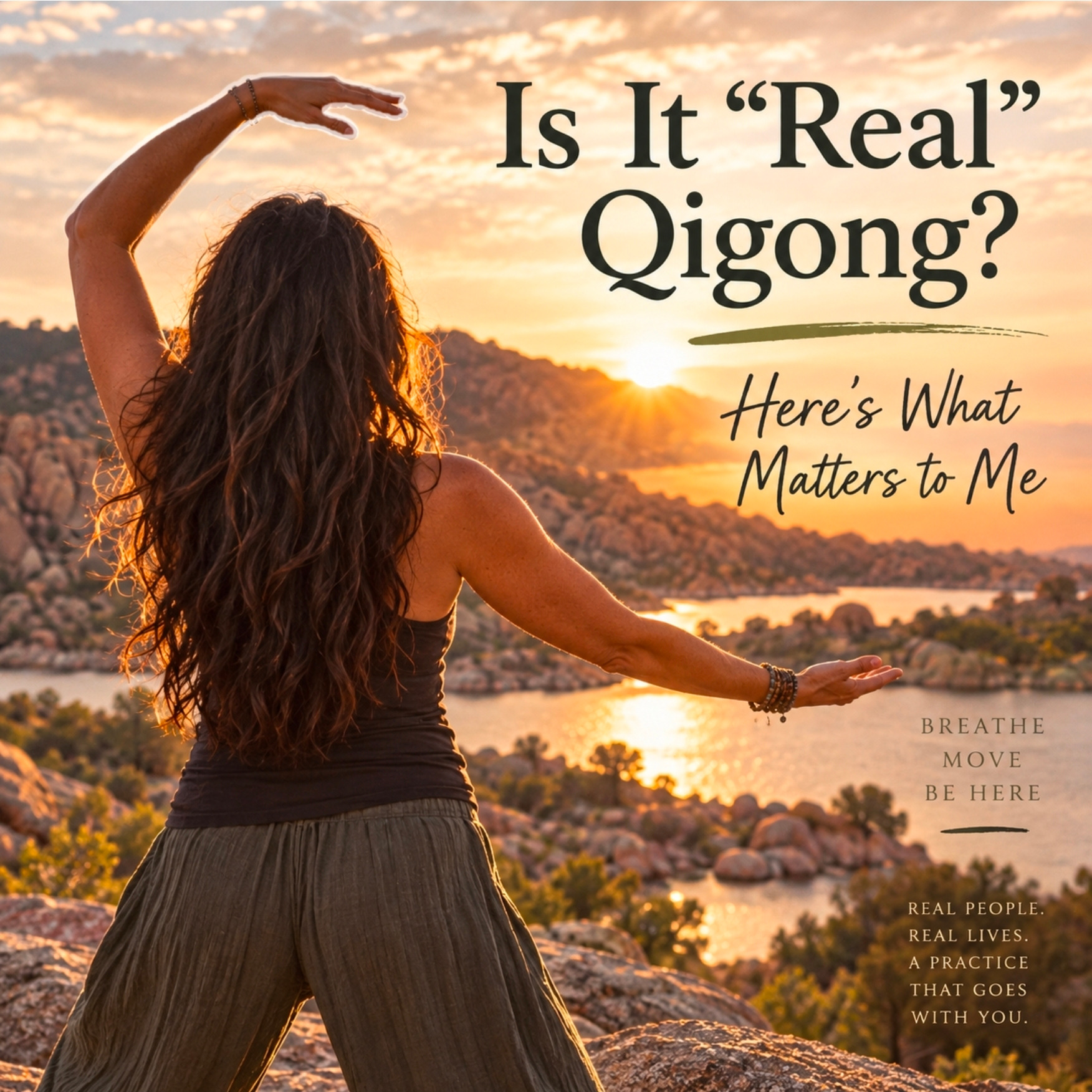
“Look!”
She was standing in front of me with her arm raised over her head and a huge smile on her face.
When she first came to class, she couldn't do that.
She had been dealing with a shoulder injury and significant limitations in her range of motion. We adapted movements when we needed to. She kept practicing. A few classes later, she walked up to me, lifted her arm, and showed me what her body could do now.
“Look.”
I've had quite a few moments like that over the years.
I've had students come into class dealing with digestive discomfort and tell me afterward that their pain was gone.
I had a firefighter who had been injured on the job come to my classes almost every day for about six months. He didn't want to rely on pain medication, and he told me that the only time his pain went away was while he was practicing Qigong.
I've worked with people who were afraid of falling and relied on a cane or walker for stability. After weeks of practicing weight shifting, grounding, balance, awareness, and movement, I've watched them become steadier and more confident. I've had students tell me they no longer needed the support they had depended on when they first walked through the door.
I've worked with people recovering from concussions who told me that practices involving coordination and brain integration made a significant difference in the symptoms they were experiencing.
And I've worked with plenty of people who weren't injured or dealing with a physical problem at all.
They were simply overwhelmed by life.
One woman was deeply worried about her grandson, who was facing spinal surgery. She was distraught. We worked with where her attention was going, with her breath, with her body, and with how she was directing all of that frightened energy.
She later told me that what she learned changed not only how she moved through the experience, but how her son and grandson did too. Eventually, hospital staff asked her to share what she had learned with other families going through the same surgery.
Another student cares for her mother, who has Alzheimer's. She once told me that she schedules the rest of her life around her Qigong classes because without it, she doesn't know how she would face the day.
Then there was the student I visited in the hospital after she'd experienced a serious heart-related episode.
She told me that when it was happening, she heard my voice in her head.
Breathe deeper.
Place your hand over your heart.
Guide the energy.
When she told me that, it brought tears to my eyes.
Because in that moment, she wasn't trying to remember a form. She wasn't concerned about whether she was performing a movement correctly. She reached for something she had practiced enough that it was there when she needed it.
The practice had left the classroom.
Those are the moments I think about when someone starts talking about “real Qigong.”
Because eventually someone will.
I've been teaching Qigong and Tai Chi for over a decade. I've been around long enough to know how these conversations go. "This movement isn't traditional enough. That teacher changed something. This isn't the correct lineage. That's not how this form is supposed to be performed."
To be fair, some of those conversations matter.
Qigong isn't simply waving our arms around and calling whatever we're doing Qigong.
There are principles underneath these practices.
Structure matters. Alignment matters. Proper form matters. Breath matters. How we organize and move the body matters. Relaxation without collapse matters. Attention and intention matter. Learning to tune into Qi and experience the flow of energy through our own bodies matters.
Tradition matters too.
These practices didn't appear out of nowhere. Generations of people studied them, practiced them, refined them, preserved them, and passed them forward. I have enormous respect for that.
But tradition isn't something we preserve behind glass. It stays alive because we practice it in living, changing bodies.
And living bodies are different.
The person standing in front of me might be twenty-five or eighty-five. They might be strong and athletic. They might have limited mobility. They might be recovering from an injury. They might need to practice sitting in a chair. They might be grieving. They might be frightened of falling. They might be exhausted from caring for someone they love. They might simply be stressed as hell.
My job isn't to force every one of those bodies into an identical expression of a movement.
My job is to understand the principles well enough that I can help the person in front of me experience them in the body they have today.
That doesn't mean technique doesn't matter.
In fact, I would argue that proper form matters because people matter.
I care about someone's alignment because I want them moving in a way that supports their body. I care about structure because good structure can create stability and reduce unnecessary effort. I care about breath because breath changes how we experience ourselves. I care about awareness because so many of us spend enormous portions of our lives disconnected from what is happening inside our own bodies.
I teach people to tune into Qi because Qigong eventually becomes something more than following a teacher's movements.
We begin experiencing it for ourselves and carrying that awareness beyond the classroom.
That experience won't always look exactly the same from one person to another.
Neither will the practice.
There are Qigong teachers whose primary purpose is preserving a particular lineage or form. There are teachers focused on martial applications, internal cultivation, spiritual development, health practices, or other aspects of these enormous traditions.
There is room for that.
But somewhere along the way, every teacher has to answer a very simple question.
What am I teaching this for?
For me, the answer has become clearer with every year I teach.
I want people to leave feeling better than they did when they walked in the door.
Maybe their shoulders have dropped an inch.
Maybe they're breathing more deeply.
Maybe they feel their feet underneath them for the first time all day.
Maybe they discover that their body can do something they thought it couldn't do anymore.
Maybe they experience their Qi in a way they never have before.
Maybe nothing dramatic happens at all. They simply spend an hour breathing, moving, laughing, becoming quiet, and coming back into themselves.
Then they take that experience home.
They use it when they're hurting.
They use it when they're frightened.
They use it when they're caring for someone they love.
They use it when life gets loud and their nervous system has had enough.
Sometimes they may even find themselves in a hospital room, frightened and uncertain, and discover that somewhere inside them they still remember what to do.
Breathe.
Come back into the body.
Work with the energy that is here.
Eventually, Qigong isn't something that happens only during class.
It becomes something we carry into our lives.
So when I think about what makes Qigong “real,” I don't think first about whether every hand is positioned at exactly the prescribed height or whether every movement looks identical to the way someone taught it fifty or five hundred years ago.
I think about the woman standing in front of me, grinning, with her arm raised above her head.
“Look.”
I think about someone discovering that the practice is still there when she needs it most.
I don't teach people so they can become good at Qigong.
I teach Qigong so they have something they can carry with them into their lives. Something that helps them inhabit their own lives more fully, whatever that life happens to be asking of them.
For me, that's what the practice is for.
BACK TO BOOKS & WRITING